Book excerpt: "Family of Spies" by Christine Kuehn
We may receive an affiliate commission from anything you buy from this article.
Christine Kuehn uncovered a devastating family secret long hidden by her father: her grandfather, Otto, was a Nazi spy who passed military information on to the Axis powers in the run-up to the attack on Pearl Harbor.
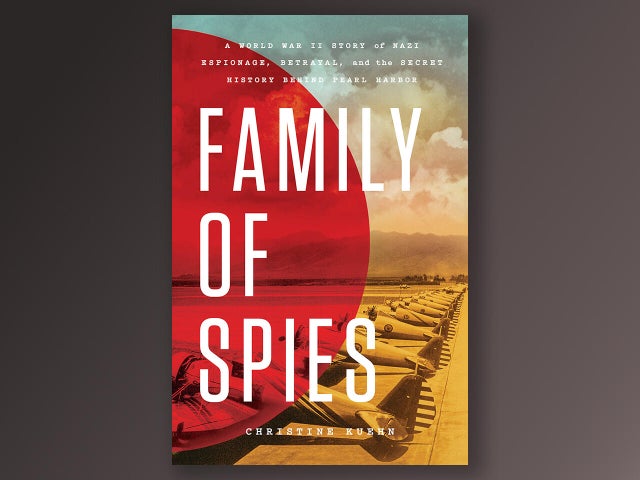
She writes about her relatives' long-hidden ties to Nazi Germany in "Family of Spies: A World War II Story of Nazi Espionage, Betrayal, and the Secret History Behind Pearl Harbor" (Celadon Books).
Read the excerpt below, and don't miss David Martin's interview with Christine Kuehn on "CBS Sunday Morning" December 7!
"Family of Spies" by Christine Kuehn
Prefer to listen? Audible has a 30-day free trial available right now.
"Don't say anything"
When you're young, you believe the stories your father tells you. And my father—lovable but imposing, a strapping six feet three inches tall with a thick, bristly mustache and a rumbling Sergeant Schultz accent that frightened my friends half to death—loved to tell stories. His family had moved to Hawaii from Germany when he was a child, but his strange way of pronouncing words never quite disappeared. Our family dogs, Nase and Scheu, were anointed with German names, a nod to his heritage, but there wasn't much else he divulged that would give us a feel for his formative years.
When talking about his past, my dad described his parents—his whole childhood, really—in vague, whitewashed snippets, offering little detail. The stories, as they came down to me, reminded me of old-timey telegrams: I lived on Oahu, in Hawaii, until I graduated from Punahou High School in 1944. Stop. I joined the army and fought in World War II. Stop. I was sent to Okinawa and earned a Bronze Star. Stop. It was the same when describing his family: My father served as a naval officer before dying in a car crash. Stop. End of discussion.
Occasionally, tiny details slipped out, but they were mostly about other people or the larger historical forces that sent him to war. "I went to the South Pacific," my father told me once. "Because if American soldiers with German names were captured by the Nazis, they suffered mightily for betraying the homeland. They told me if a U.S. soldier with German blood was captured by the Reich," he said, his face blank, "they were badly tortured."
But then it was back to his telegrams. I served again in Korea, then moved to New Jersey and married my first wife. Stop. We had two sons, but eventually divorced. Stop. I married your mom and we settled in Jacksonville. Stop. She had three children from an earlier marriage. Stop. You were born in 1963. Stop.
It had all led him to a quiet, normal life.
My father kept us away from his first family. He spoke very little about his wife and kids from the earlier marriage, and they had no contact. A picture of his two sons, framed in his office, was all we knew of them.
Life tumbled forward. In our family we rarely spoke about my dad's past. But on a sultry and dull June evening in the summer of 1976, his past arrived at our door. I was eating dinner with my mom and dad when the doorbell rang.
I jumped up to answer it, hoping, I'm sure, it was a friend from the neighborhood wanting to hang out. Instead, it was a man, tall and wiry, much like my dad.
"Can I help you?" I asked, a little sheepishly.
"Is your dad home?" he responded.
I had no idea who this tall stranger with a bristly mustache was, so I ran back to the kitchen.
"Hey, Dad, there's a man at the front door, he's looking for you. Says you know him."
Dad got up quickly and disappeared down the hallway. When he got to the door, he recognized the man immediately. It was almost like looking in a mirror.
On the other side of the screen door was a man in his twenties, fair-skinned, tall like my father, his face obscured by the cross-hatching of the metal.
"Don't say anything about my family—they don't know!" were the first words out of my dad's mouth as he stepped outside and closed the door behind him. He was talking about his parents, brothers, and sister. Then he hugged the man he hadn't seen in more than ten years. It was his eldest son, my half-brother, who years later would tell me the details of their reunion.
I didn't piece it together at the time, but in retrospect, that moment was the first glimpse that my dad had secrets.
I later learned he hadn't always been so guarded and cryptic about his past. He had married relatively young, at age twenty-three. He told his new bride everything—his tragic upbringing, the sins of the family. He was young and in love. There was nothing to hide.
They had two sons and led a quiet, happy life in the suburbs, the tragedies of his past finally vanquished to a place in the recesses of his memory. But as the years rolled by, things began to slowly unravel. By the time the boys were out of diapers the screaming fights between my dad and his first wife were becoming commonplace.
The arguments were ugly and heated, both sides hurling insults like bombs. Toward the end, when they'd burned through whatever love they had left for each other, his wife took to hitting him where it hurt most, invoking the past.
"Nazi!" she would yell at him. "Go back to Germany, where you belong!"
It had to be a crushing insult. A painful legacy he confided to a person he loved had been turned against him, dredging up the agonizing memories of his past. He wouldn't make that mistake again.
Kensington, Maryland
Eighteen years after that unexpected visit from my estranged half-brother, on a Friday afternoon in the summer of 1994, I snagged a handful of mail and sifted through it as I made my way toward the kitchen. Mostly junk and a couple of bills. One letter, though, looked different. It was addressed to Christine Kuehn, my maiden name, typed in a formal bold, black print. The return address was from California, and the sender wasn't familiar to me.
I slid my finger into the corner of the envelope and opened it. When Mark came down twenty minutes later, I was staring into the distance. Mark dropped onto the couch next to me. He could see something was wrong.
"I got a weird letter," I said. "Some guy writing a movie about World War II."
The mysterious screenwriter was asking about my grandfather on my father's side. Dad had always told me his father was a naval officer who'd had an unexceptional career and died suddenly in a traffic accident. But the letter said something different: that Otto Kuehn had been involved with the Nazis.
The word Nazi seemed to burn itself into the stationery. Mark stared at me, thoroughly puzzled. I handed him the note. The screenwriter was researching the Japanese attack on Pearl Harbor and the role of German spies in the tragedy. He was trying to contact my father.
"Seems crazy," Mark said, after reading the letter. "Your dad would have told you something if this were true, wouldn't he?"
I started to say something but stopped. Actually, I thought, my dad never really said much about his family. Or the past.
"There are lots of Kuehns in the phone book," Mark said. "He must have the wrong ones. Or maybe he's just a crackpot."
I pushed up from the couch to head to bed. Has to be the wrong Kuehns, I thought.
I considered calling my father and asking him to dismiss the whole thing, but it seemed so far-fetched that I didn't want to bother him with some wild speculation about Hitler and the war and all that horror. He had always been vague and evasive about his father's naval career and his death. Besides, we were true-blue patriotic Americans; my father had served in two wars and hung an American flag outside the house every Fourth of July.
I went to bed that night thinking I would write the screenwriter back and tell him he had the wrong family.
From "Family of Spies: A World War II Story of Nazi Espionage, Betrayal, and the Secret History Behind Pearl Harbor" by Christine Kuehn. Copyright © 2025 by the author and reprinted with permission of Celadon Books, a division of Macmillan Publishing Group, LLC.
Get the book here:
"Family of Spies" by Christine Kuehn
Buy locally from Bookshop.org
For more info:
- "Family of Spies: A World War II Story of Nazi Espionage, Betrayal, and the Secret History Behind Pearl Harbor" by Christine Kuehn (Celadon Books), in Hardcover, eBook and Audio formats
Gallery: Pearl Harbor - Day of Infamy
Remembering December 7, 1941, when a Japanese air attack on Hawaii pulled the U.S. into World War II.