Book excerpt: "Eat Your Ice Cream" by Ezekiel J. Emanuel, M.D.
We may receive an affiliate commission from anything you buy from this article.
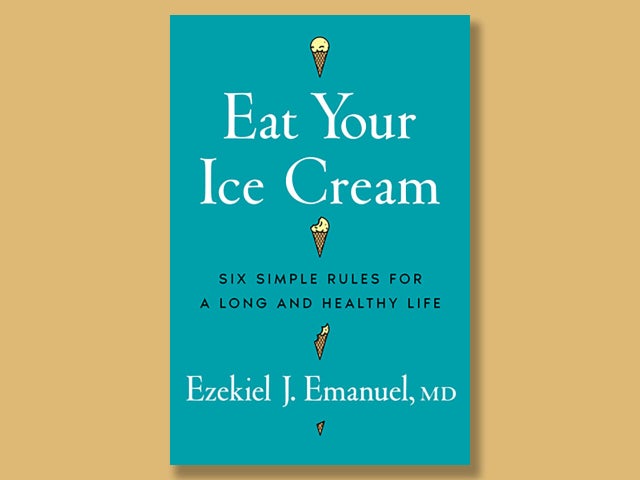
In his new book, "Eat Your Ice Cream: Six Simple Rules For a Long and Healthy Life" (to be published Tuesday by W.W. Norton & Co.), Dr. Ezekiel Emanuel, an oncologist and health policy expert, discusses longevity, and how to best differentiate valid and effective health and wellness advice from "the speculative, deceptive, and just plain stupid."
Read an excerpt below, and don't miss Norah O'Donnell's interview with Emanuel on "CBS Sunday Morning" January 4!
"Eat Your Ice Cream" by Ezekiel J. Emanuel, M.D.
Prefer to listen? Audible has a 30-day free trial available right now.
Anyone looking for advice on wellness and longevity confronts a tsunami of books, newspaper articles, podcasts, newsletters, and videos from an enormous range of sources: scientific experts, medical practitioners, health systems, journalists, patients, influencers, gurus, quacks. Traditional media offer loads of good advice, often in responsibly edited and well-sourced sections dedicated to "wellness." But the sheer amount of it can be difficult to keep up with, and sometimes the guidance can be downright contradictory.
For anyone wading through the torrent of health and longevity advice online, it can be difficult to know who to trust. The so-called "must dos" online range from the medically unproven to the wildly impractical to suggestions so absurd they leave doctors like me baffled—testicle tanning, teen blood transfusions, vaginal steaming, "rucking" hikes with a backpack full of weights. Information is coming at us from a firehose, increasingly spewed by hucksters and self-proclaimed sages who have amassed millions of social media followers (and dollars) by promising supposed miracle treatments using medical-sounding language. It's no wonder so many people are confused and frustrated.
Shouting to be heard over it all are real physicians and health experts offering sound but sometimes conflicting advice. All of it together can swamp even those who are most assiduous about their health. Dozens of books on health and longevity have appeared in just the last few years, filled with well-intentioned and scientifically accurate information. But too often they fall into the trap of chasing novelty instead of efficacy and end up touting treatments and regimens that are unproven or with marginal returns at best.
Then there is the steady stream of profiles on tech billionaires joylessly devoting themselves to maximizing their lifespan. One of my business school students told me how her "wellness coach" recommended all sorts of questionable prescriptions, like eating 200 grams of meat a day. (Don't ask me why a perfectly healthy twentysomething student who isn't training for a marathon or Ironman needs a wellness coach.) And then there is the entrepreneur attempting to defy death with his daily regimen of 100 pills, cold plunges, infrared lights, and a daily serving of "nutty pudding"—a mix of chia seeds, macadamia nuts, and berries. Nutty is right.
With so much health and wellness advice out there, it can be nearly impossible to differentiate the valid, reliable, and effective from the speculative, deceptive, and just plain stupid. Even when the advice is scientifically sound, it's often extraneous, misrepresented, or misused. For example, one wellness book ventures into the basic biology of molecular pathways, like the mTOR pathway for cell survival, to explain why you should take rapamycin to improve longevity. Indeed, studies have shown rapamycin extends the lifespan of mice, worms, flies, and yeast. But you are not a mouse, worm, fly, or yeast. While some studies have suggested that rapamycin for humans may mitigate the impact of aging-related immune and cardiovascular diseases, there is no evidence that it impacts human lifespans.
This extrapolation of laboratory findings parallels the story of resveratrol, the "magic" compound in grapes and red wine that was supposed to explain the French paradox. Yes, resveratrol improved longevity in mice. But, do you have a tail and whiskers? Scientists have been experimenting on mice since the early 20th century, and while this work has led to many breakthroughs, findings in mice often fail to extend to humans. As an oncologist, I know that researchers have cured hundreds of thousands of mice with cancer using experimental chemotherapy agents, only to have the drugs fail when administered to people with cancer. Unfortunately, there's no evidence that resveratrol or rapamycin improves human lifespans. Ultimately, the biology lesson and the "health advice" is a waste of people's time.
What so many of these talking heads have in common—legitimate experts, well-meaning journalists, and kooks alike—is how costly their recommendations are. Financially, for sure, but also costs in mental energy and time that steal from activities which give life meaning. With the mountain of advice out there, it is practically a full-time job to determine whether the information on rapamycin is accurate, not to mention if it is worth taking.
Overall, the wellness industrial complex promises us more time to enjoy in the future—but sure is demanding a lot of time right now. It takes a ton of time and attention to pore through a 400-page book, much less a whole library of them. And what about the zillions of posts, videos, and articles about the latest new supplement, superfood, or exercise that supposedly can lengthen your life? Add that to the time spent trying to figure out what is real versus what is a fad. Or based on some microbes in a petri dish or a study of worms. Or worse yet, based on no evidence at all. Then budget more time to methodically organize your schedule to incorporate the latest exercise tweak or diet advice. . . . Congratulations: You have now lost that added time the gurus promised you. And you've lost it in the prime of your life.
Of course, if your whole focus is on quantity of years rather than quality, this work could be worth it. Some "longevity experts" seem to see things that way. As one popular author says, "Our only goal is to live longer and live better—to outlive." Our only goal? Life is not a competition where the gold medal goes to the oldest! Our goal should not be to "outlive" as many people as possible. Instead, the goal should be to live a healthy and fulfilling life. Wellness is just a means to that end, not the end in itself.
From "Eat Your Ice Cream" by Ezekiel J. Emanuel, M.D., published by W.W. Norton & Company. Copyright 2025 by Ezekiel J. Emanuel, M.D. All rights reserved.
Get the book here:
"Eat Your Ice Cream" by Ezekiel J. Emanuel, M.D.
Buy locally from Bookshop.org
For more info:
- "Eat Your Ice Cream: Six Simple Rules for a Long and Healthy Life" by Ezekiel J. Emanuel, M.D. (W.W. Norton & Co.), in Hardcover, eBook and Audio formats, available January 6
- Ezekiel Emanuel, M.D.